This dental office sped up its workflow with new tech
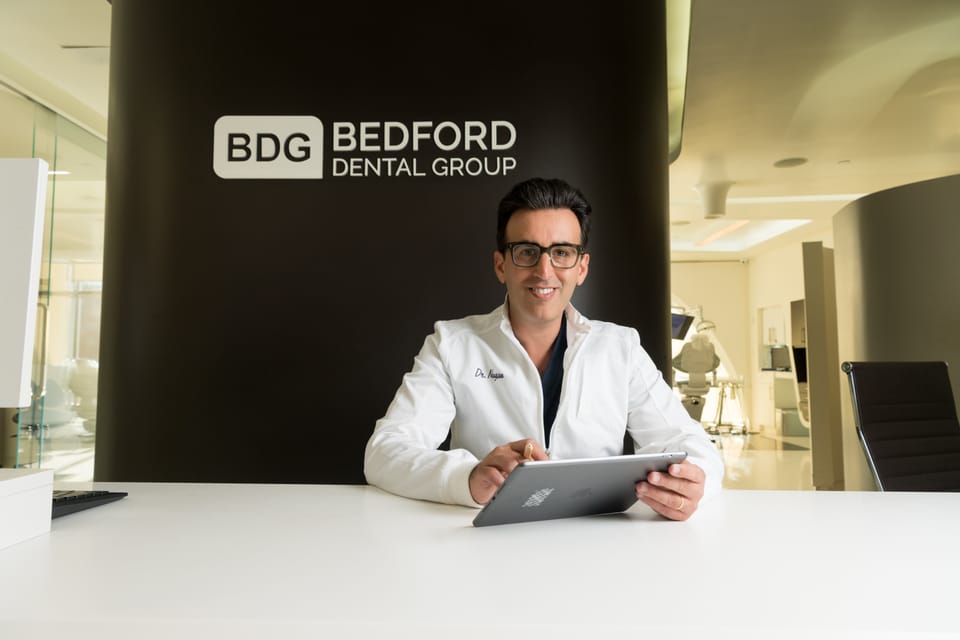
Artificial intelligence continues to be an exciting topic in dentistry. It has the potential to reshape the way dentists approach treatment planning, communicate with patients and deliver care. Daniel Naysan, DDS, a cosmetic dentist and founder of Bedford Dental Group, talked to Dental Bite about how his practice is currently using the technology and about new AI-driven capabilities on the horizon.
—Interview by Carrie Pallardy, edited by Bianca Prieto
How have you integrated AI-driven diagnostic and treatment planning technology into your practice thus far?
I love technology and artificial intelligence. It's playing a big role in not only the world, but also in medical and dental practices. I am actually part of a company called Pearl. It does radiographic detection of any type of dental abnormalities. People think of cavities, but it's more than that. It's defective restorations, bone loss, calculus and periapical lesions.
It has built-in software called Practice Intelligence. It integrates with your PMS, and it highlights for your front office: your schedule, patients, what they need, if they need radiographs, if they're due for bite wings or a full series of x-rays. Not only that, but it also subcategorizes them into specific treatments that are required for those patients.
Let's say you have 22 patients a day and three of those need SRPs, which are the deep cleanings. Five of them need possible root canals because of the lesions that it's detecting. The reason why it works effectively for our practice is that we have a multi-specialty practice. I do all the general and cosmetic dentistry, and then I have specialists for everything. We can have the specialists identify and reevaluate those patients who are coming in for those specialty needs.
How are you planning to expand AI-driven capabilities in 2026?
I'm actually partnering up with a company—it's not finalized—but they are integrating robotics. It has three components. There is CAD/CAM, which I'm sure you're familiar with. There is another technology that's coming out, hopefully in the next 18 months. It's called OCT, which basically has no radiation and detects cavities and cracks up to a hundredth of a nanometer micron.
The way it works is the AI reads this information and determines how deep the defect is. It integrates with CAD/CAM, and it prefabricates the porcelain bonding restoration.
Let's say you have a filling that needs to be done. It basically does a minimal preparation of exactly the amount of tooth structure that is defective, prefabricates it and the robot comes in and does the drilling, of course, with the guidance of the dentist. The dentist will anesthetize. The robot will do the preparation, and the dentist will have the porcelain bonded restoration prefabricated from the CAD/CAM and delivered within 20 minutes.
You're talking about lowering treatment time by 5x. This is a significant improvement in the workflow. Patients will have a better experience. Dentists won't have burnout. You're going to start to see practices be able to do more at once.
When do you expect you could see it actually in clinical practice? Do you have an expectation for that?
Probably in a three- to five-year window.
What has the learning curve looked like for your practice as you integrate these new capabilities?
The learning curve specifically for artificial intelligence in dentistry so far has been very minimal. It's actually making our life easier from the get-go, because with patients everything is visual. When they see something, they understand it better.
The beauty of Pearl specifically: it's highlighting in the tooth parts what specifically is the abnormality. What is the defect in that tooth? It's showing it to the hundredth of a millimeter. The staff actually appreciates it more because there's less talking. It's more visual. When I show you an image, I need to say less. The patient comes in and says, “What is that?” It's an avenue for more of a dialogue between the dentist and the patient, versus the dentist just talking to the patient.
The benefits?
It's patient acceptance, treatment acceptance. I started practicing in 2006. I know 20 years doesn't seem like a long time, but a lot of things have transpired in this time. When I started practicing, we would basically take X-rays with film. The dentist would come in and put the X-rays against the light and use the magnet. A class two lesion looked like the size of literally a piece of sand. The patient couldn't see exactly what you're talking about. You could be completely lying, and the patient wouldn't know.
Right now, when you're using this technology, when you're using these visuals, it’s difficult for patients to contradict what the doctor's recommending. It is the second opinion.
This conversation has been edited for brevity and clarity.
Thanks for reading today's edition! You can reach the newsletter team at newsletter@dentalbite.co. We enjoy hearing from you.
Interested in advertising? Email us at newslettersales@mvfglobal.com
Dental Bite is curated and written by Carrie Pallardy and edited by Bianca Prieto